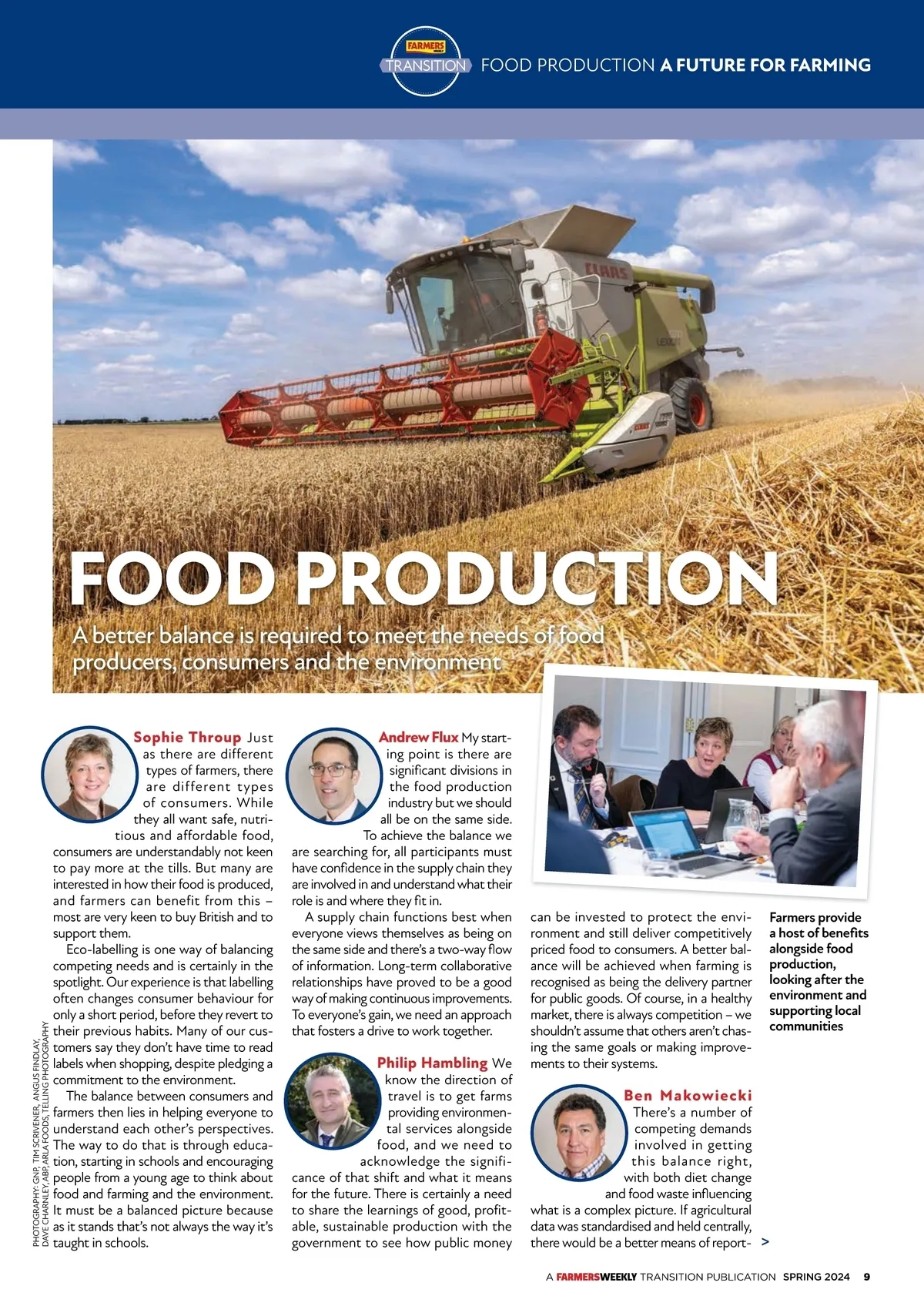
FOOD NATURAL PRODUCTION CAPITAL A FUTURE FOR FARMING FOOD PRODUCTION A better balance is required to meet the needs of food producers, consumers and the environment Sophie Throup Just Andrew Flux My start-as there are different types of farmers, there are different types of consumers. While they all want safe, nutri-tious and affordable food, consumers are understandably not keen to pay more at the tills. But many are interested in how their food is produced, and farmers can benefit from this – most are very keen to buy British and to support them. Eco-labelling is one way of balancing competing needs and is certainly in the spotlight. Our experience is that labelling often changes consumer behaviour for only a short period, before they revert to their previous habits. Many of our cus-tomers say they don’t have time to read labels when shopping, despite pledging a commitment to the environment. The balance between consumers and farmers then lies in helping everyone to understand each other’s perspectives. The way to do that is through educa-tion, starting in schools and encouraging people from a young age to think about food and farming and the environment. It must be a balanced picture because as it stands that’s not always the way it’s taught in schools. ing point is there are significant divisions in the food production industry but we should all be on the same side. To achieve the balance we are searching for, all participants must have confidence in the supply chain they are involved in and understand what their role is and where they fit in. A supply chain functions best when everyone views themselves as being on the same side and there’s a two-way flow of information. Long-term collaborative relationships have proved to be a good way of making continuous improvements. To everyone’s gain, we need an approach that fosters a drive to work together. know the direction of travel is to get farms providing environmen-tal services alongside food, and we need to acknowledge the signifi-cance of that shift and what it means for the future. There is certainly a need to share the learnings of good, profit-able, sustainable production with the government to see how public money PHOTOGRAPHY GNP, TIM SCRIVENER, ANGUS FINDLAY, DAVE CHARNLEY, ABP, ARLA FOODS, TELLING PHOTOGRAPHY Philip Hambling We can be invested to protect the envi-ronment and still deliver competitively priced food to consumers. A better bal-ance will be achieved when farming is recognised as being the delivery partner for public goods. Of course, in a healthy market, there is always competition – we shouldn’t assume that others aren’t chas-ing the same goals or making improve-ments to their systems. Farmers provide a host of benefits alongside food production, looking after the environment and supporting local communities There’s a number of competing demands involved in getting this balance right, with both diet change and food waste influencing what is a complex picture. If agricultural data was standardised and held centrally, there would be a better means of report-> A FARMERS WEEKLY TRANSITION PUBLICATION SPRING 2024 9 Ben Makowiecki
A Future For Farming Spring 2024: Page 9